Showing posts with label peace. Show all posts

Sunday, February 11, 2007

Deeply Held Belief in Nonviolence


I was talking to a friend of mine yesterday about a mutual hobby, tabletop gaming. We are both huge fans of the Lord of the Rings universe and play Games Workshop's Lord of the Rings Strategy Game. Tactics play the major role in this game, as each player controls an army comprised of units from within the Lord of the Rings mythology--elves, men, dwarves, Gandalf, Saruman, etc.--and fights a battle with their forces against the other player. To give our games some depth and meaning, however, we created a strategic world within which we play the game. In other words, it's closer to "real life" in that the results of our battles ripple through our respective Middle Earth empires. When (and if) to attack, how much force to use in doing so, what additional units to produce to strengthen our armies, where to maneuver--all of these are now important factors for which we have to account. Said another way, instead of just playing the role of a Field Commander in a single battle, we now play the roles of President, General, Defense Minister, and Foreign Relations Advisor, as well as Field Commander.

While we discussed our game and what appears to be an impending invasion of my territory by my friend, I noticed how uncomfortable I felt regarding our war. I love fighting our individual battles for the strategic challenge they present, just as I enjoy chess, Go, and other such games. But the more my job becomes "leading an empire," the more I shy away from warlike tendencies.

I think back to my college days, when I frequently played the computer game Civilization. In that game, you are charged with leading your chosen civilization from a single settler in antiquity to launching a manned spacecraft to Alpha Centauri, our nearest star, in the 21st century CE. Across this vast span of time, you can lead your civilization in an infinite number of ways, including creating and breaking diplomatic ties, choosing your form of government, forging trade routes, building Wonders of the World, and waging war. I always, always, always tried to win via diplomatic relations, and could never bring myself to wage war on the other civilizations, except under self-defense.

In Buddhism, the number one moral teaching is, "Do not harm, but cherish all life." All other ethical actions can be reduced to this one teaching--we should not lie because of the harm it can have on others as well as ourselves (we count as "all life" too!), we should avoid stealing because of the pain it causes others, etc. In November of 2005, the Dalai Lama gave a talk on the heart of nonviolence, and here is an excerpt from Stanford University's coverage of the event:

"Violence is destruction; nonviolence is construction," he [Dalai Lama] said.

But the boundaries between violence and nonviolence cannot be determined simply by observing actions on their surface, he said. An individual can use nice words to cheat or exploit another, he said. Conversely, a harsh action could be done out of compassion and the intent to protect others, he added. Limited violence can be permissible, and countering a violent action with a strong countermeasure sometimes is not only permissible "but is the right thing to do," he said.

The organized violence of war, however, is never a lasting solution, he said. Acting out of negative emotions, however natural they may be, obscures reality, he said. In today's reality, "the whole world is like one family or one body. Destroying one part of the world is like destroying yourself," he said.

War is very hard to justify, he said. It's too early to say whether the war in Iraq is right or wrong, he added. "We'll see," he said.

As I am a Buddhist, I embrace the idea of nonviolence. But in conversing with my friend, for the first time I truly observed for myself how deeply ingrained this approach to life is in me. Even in my completely unreal fantasy game, as soon as the game gave me responsibility as the leader of a people (rather than just a General in a battle without context), I felt it was completely wrong and irresponsible of me to pursue war. Even knowing this now, and knowing that our game was designed completely around giving us a reason and a context to fight our individual battles, I still struggle inwardly with any decisions involving waging war because I deeply feel that peace is always an option, and to allow events to proceed to the point where violence is unavoidable is to have failed in my job as leader. I agree with the Dalai Lama that strong countermeasures are sometimes necessary to minimize violence and harm in the long-term (WWII and Hitler being an obvious example), but it is only under extreme circumstances that this type of action is necessary.

1-Minute Contemplation: When in your life have you had the experience of seeing a deeply held viewpoint naturally emerge? Did you expect that response? Did you know it was even there? For me, I knew I had felt violence was wrong, but it had mostly been an intellectual understanding that had provided guidance for me. Until my revealing conversation with my friend. It was only then that I truly saw for myself the depth of feeling I had of the importance of peace and harmony in the world.

Friday, September 08, 2006

Exploration of Compassion in a World of Violence


This essay is an exploration of how love and compassion can survive and prosper in a world where violence is prevalent and accepted.

I am a relative pacifist. So I often question, "Do we even need violence? Can we live without violence? Should we, given our animal-nature?"

Most people would agree that love and compassion should be shown in most situations. But what about in an Israel-Lebanon type scenario? Hezbollah kidnaps 2 of your soldiers, how do you respond? Are peaceful, compassionate protests and negotiations viable? Or does that just encourage further incursions?

In Tibet, the Dalai Lama has always forbidden violent protests or responses to China's occupation. No further "expansion" has come of this, but is that because the rest of the world would violently oppose further takeovers by China? Or is China actually content with Tibet, and the Dalai Lama's response has maintained peace where otherwise there could have been bloodshed?

I read a story recently where a Buddhist monk was held captive in a prison in Tibet, where he was beaten and tortured, kept hungry and alone. This monk fled Tibet for India, where he met with the Dalai Lama. The Dalai Lama asked him, "Was there ever a time you felt your life was truly in danger?" The monk answered, "In truth, the only time I truly felt at risk was when I felt in danger of losing compassion for my jailers." That, to me, is the most heroic modern story I have ever heard. But if we had a majority of people committed to compassion like this Buddhist monk, would they be overcome by those who would take advantage of them?

This makes for an interesting paradox. Christ called for a turning of our other cheek, the Buddha instructed us not to harm other beings; but if we do this, will militant, extremist factions attack us out of their own misguided self-interest? Yet these great sages were the most wise people who ever lived, and we put great faith in their teachings. We must at least consider their advice.

So what is the answer? I don't think there is an absolute, correct answer to this dilemma. Dogmatic, doctrinal answers fail us here, as they do everywhere. We must apply wisdom to, and account for the practical parameters of, the situation. Our great sages' calls for peace and love and compassion form the ultimate path, the one we try our hardest to follow. But in our current world, many extremists may take this as an invitation to further their own self-interests, territorial and cultural, uncontested. Hence, I think that violent response remains a necessity in our current world. However, that being said, I applaud the great calls for peace, the protests, and the political movements to end war and violence, because to move toward the perfect path of peace expressed by our saints, we need to apply constant pressure on our governments to end hostilities.

For example, consider Iraq. An immediate, complete withdrawal of troops would be foolhardy, as Iraq would likely plunge into civil war. However, groups are right to call for such immediate action, to keep applying pressure to end violence. It is like walking up a down-escalator. Human violence carries us down, but we need to always be walking up, lest we collapse into a hellish state where chaotic violence is the only rule. Sometimes we may slow our walk and hence drift down slowly. But as long as we increase our pace often enough, we can continue making progress toward a life of compassion and turning our other cheek.


Wednesday, August 02, 2006

Set Winning and Losing Aside


From the Sangama Sutra, trans. by Thanissaro Bhikkhu:
Winning gives birth to hostility.
Losing, one lies down in pain.
The calmed lie down with ease,
having set
winning & losing
aside.

The Buddha uttered this verse when told of the defeat in battle of King Pasenadi at the hand of King Ajatasattu. Given the context, this verse was a commentary on warfare. I think it is particularly appropriate given the violence we are seeing exploding around the world today.

What do we gain by having to win? Anything more than an ego boost? I think it's very east to get caught up in rationalizing our behavior, justifying the means by the ends achieved, and lose sight of the brutality inherent in the means. I think our government is caught up in this quagmire of rationalization and ego.

In an essay entitled A Human Approach to World Peace, the Dalai Lama wrote:
Of the many problems we face today, some are natural calamities and must be accepted and faced with equanimity. Others, however, are of our own making, created by misunderstanding, and can be corrected. One such type arises from the conflict of ideologies, political or religious, when people fight each other for petty ends, losing sight of the basic humanity that binds us all together as a single human family. We must remember that the different religions, ideologies, and political systems of the world are meant for human beings to achieve happiness. We must not lose sight of this fundamental goal and at no time should we place means above ends; the supremacy of humanity over matter and ideology must always be maintained.

Violence is never the answer.


Thursday, June 08, 2006

War, Ethics, and Religion

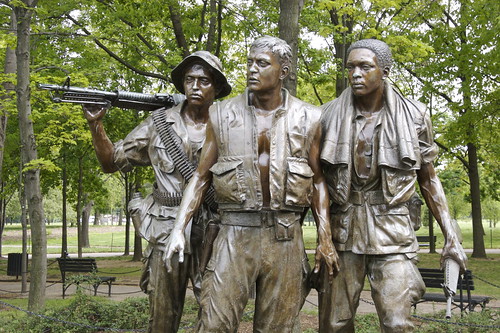
Vietnam War Memorial - The Three Soldiers or The Three Servicemen

I read an interesting article today entitled World Religions: War and Peace, which asserts that religions can take one of three views regarding war:
  • Pacifist: War (and violence) is wrong.
  • Just War: War can be justified under certain circumstances.
  • Holy War: War is justified if it is a Holy War, ordained by the god of the religion.

I'm impressed by the unbiased approach taken in the article. For instance, it correctly denotes that Buddhism is a pacifist religion, but does not shy away from noting that the Buddhist regime in Sri Lanka is seen as oppressing the Hindu minority.

The article got me thinking, where do I stand? I find myself in the pacifist camp, with a caveat. I, personally, feel it's ok to defend oneself if attacked. As Bodhisattvas, it is our responsibility to achieve awakening for the benefit of all beings and, in the process, imbue all of our thoughts, actions, and speech with generosity, ethical restraint, patience, joyous effort, concentration, and wisdom (Six Paramitas), for the benefit of others. But if we are attacked, it inhibits our ability to fulfill our Bodhisattva vows. Therefore, for the benefit of others, we are justified, I feel, in defending ourselves. However, there is a caveat to this, as well. We must NOT do so out of anger and hate. This would allow the unwholesome roots to rule our actions. We must defend ourselves out of compassion. In this way, we will do no harm beyond that which is necessary.

Buddhism is not dogmatic. Our precepts are not dictates—they are generalities based upon observation of actions-results and wisdom. "To do no harm" is our greatest precept, but, as in all things, the compassion that inhabits it must be tempered with wisdom. As a result, war is almost never black & white. Was our invasion of Iraq ethical? Pacifists would say no. The "Just War" camp might say yes, depending on their predilections. In my view, I lean toward no, because the information upon which we based our invasion was incorrect. We were truly in no danger from Iraq. Were the people of Iraq oppressed? Arguably, yes. Was invasion the best way to intervene? I don't think so.

1-Minute Contemplation: Is violence always wrong? If not, when is it justified?